

Describe How Computer Generated Imagery Works. How Has It Benefited Animation?
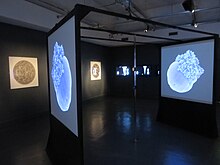
Figurer-generated imagery (CGI) is the application of figurer graphics to create or contribute to images in fine art, printed media, video games, simulators, computer blitheness and VFX in films, boob tube programs, shorts, commercials, and videos. The images may be dynamic or static, and may exist ii-dimensional (2D), although the term "CGI" is most normally used to refer to the iii-D computer graphics used for creating characters, scenes and special effects in films and television, which is described as "CGI blitheness".
The starting time feature film to make use of CGI was the 1973 picture Westworld.[1] Other early films that incorporated CGI include Star Wars (1977),[1] Tron (1982),[i] Golgo thirteen: The Professional (1983),[2] The Concluding Starfighter (1984),[3] Young Sherlock Holmes (1985)[one] and Flying of the Navigator (1986).[four] The beginning music video to use CGI was Dire Straits' award-winning "Coin for Nothing" (1985), whose success was instrumental in giving the process mainstream exposure.[5]
The evolution of CGI led to the emergence of virtual cinematography in the 1990s, where the vision of the simulated camera is non constrained by the laws of physics. Availability of CGI software and increased computer speeds have allowed private artists and small companies to produce professional-grade films, games, and fine art from their abode computers.[ citation needed ]
The term virtual world refers to agent-based, interactive environments, which are now[ when? ] created with CGI.
Static images and landscapes [edit]
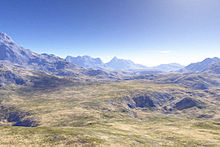
Not only do animated images form part of estimator-generated imagery; natural looking landscapes (such equally fractal landscapes) are as well generated via computer algorithms. A unproblematic style to generate fractal surfaces is to utilize an extension of the triangular mesh method, relying on the construction of some special case of a de Rham bend, e.thousand. midpoint displacement.[6] For instance, the algorithm may kickoff with a large triangle, so recursively zoom in by dividing it into four smaller Sierpinski triangles, then interpolate the tiptop of each indicate from its nearest neighbors.[6] The creation of a Brownian surface may exist achieved not only by adding noise as new nodes are created but by adding additional noise at multiple levels of the mesh.[six] Thus a topographical map with varying levels of summit can be created using relatively straightforward fractal algorithms. Some typical, easy-to-plan fractals used in CGI are the plasma fractal and the more dramatic mistake fractal.[seven]
Many specific techniques been researched and adult to produce highly focused calculator-generated effects — eastward.1000., the use of specific models to represent the chemic weathering of stones to model erosion and produce an "aged appearance" for a given stone-based surface.[8]
Architectural scenes [edit]

A computer-generated image featuring a house at dusk, made in Blender.
Modern architects use services from computer graphic firms to create 3-dimensional models for both customers and builders. These computer generated models can be more accurate than traditional drawings. Architectural animation (which provides blithe movies of buildings, rather than interactive images) tin can likewise be used to run across the possible human relationship a building volition have in relation to the surround and its surrounding buildings. The processing of architectural spaces without the use of paper and pencil tools is now a widely accepted practice with a number of calculator-assisted architectural pattern systems.[9]
Architectural modeling tools let an architect to visualize a space and perform "walk-throughs" in an interactive manner, thus providing "interactive environments" both at the urban and building levels.[10] Specific applications in architecture not merely include the specification of edifice structures (such as walls and windows) and walk-throughs but the effects of calorie-free and how sunlight will impact a specific blueprint at different times of the 24-hour interval.[xi] [12]
Architectural modeling tools accept now become increasingly net-based. Still, the quality of internet-based systems still lags behind that of sophisticated in-house modeling systems.[13]
In some applications, estimator-generated images are used to "reverse engineer" historical buildings. For instance, a computer-generated reconstruction of the monastery at Georgenthal in Germany was derived from the ruins of the monastery, yet provides the viewer with a "look and experience" of what the building would accept looked similar in its 24-hour interval.[14]
Anatomical models [edit]
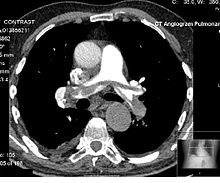
Computer generated models used in skeletal blitheness are not always anatomically right. However, organizations such as the Scientific Computing and Imaging Institute have adult anatomically correct computer-based models. Figurer generated anatomical models tin can be used both for instructional and operational purposes. To date, a big body of artist produced medical images go along to be used by medical students, such every bit images by Frank H. Netter, e.1000. Cardiac images. Still, a number of online anatomical models are condign bachelor.
A single patient X-ray is not a computer generated epitome, even if digitized. Still, in applications which involve CT scans a three-dimensional model is automatically produced from many single-slice 10-rays, producing "computer generated image". Applications involving magnetic resonance imaging also bring together a number of "snapshots" (in this case via magnetic pulses) to produce a blended, internal image.
In modern medical applications, patient-specific models are synthetic in 'calculator assisted surgery'. For instance, in total knee replacement, the structure of a detailed patient-specific model tin can be used to carefully program the surgery.[15] These three-dimensional models are usually extracted from multiple CT scans of the appropriate parts of the patient's ain anatomy. Such models can likewise exist used for planning aortic valve implantations, one of the common procedures for treating heart illness. Given that the shape, bore, and position of the coronary openings tin can vary greatly from patient to patient, the extraction (from CT scans) of a model that closely resembles a patient'south valve anatomy tin exist highly beneficial in planning the process.[16]
Material and skin images [edit]
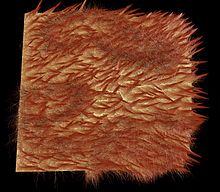
Models of cloth mostly fall into three groups:
- The geometric-mechanical construction at yarn crossing
- The mechanics of continuous elastic sheets
- The geometric macroscopic features of fabric.[17]
To appointment, making the clothing of a digital character automatically fold in a natural style remains a challenge for many animators.[xviii]
In addition to their apply in movie, advertizing and other modes of public display, calculator generated images of article of clothing are at present routinely used by top fashion design firms.[19]
The challenge in rendering human skin images involves three levels of realism:
- Photo realism in resembling real skin at the static level
- Physical realism in resembling its movements
- Role realism in resembling its response to actions.[20]
The finest visible features such every bit fine wrinkles and pare pores are the size of near 100 µm or 0.1 millimetres. Peel tin can be modeled as a 7-dimensional bidirectional texture function (BTF) or a collection of bidirectional scattering distribution part (BSDF) over the target's surfaces.
Interactive simulation and visualization [edit]
Interactive visualization is the rendering of data that may vary dynamically and allowing a user to view the information from multiple perspectives. The applications areas may vary significantly, ranging from the visualization of the flow patterns in fluid dynamics to specific estimator aided design applications.[21] The data rendered may represent to specific visual scenes that modify equally the user interacts with the system — e.m. simulators, such every bit flying simulators, make extensive utilise of CGI techniques for representing the world.[22]
At the abstract level, an interactive visualization process involves a "information pipeline" in which the raw data is managed and filtered to a form that makes it suitable for rendering. This is frequently called the "visualization data". The visualization data is and then mapped to a "visualization representation" that can be fed to a rendering organisation. This is normally called a "renderable representation". This representation is then rendered equally a displayable image.[22] Equally the user interacts with the system (e.g. by using joystick controls to modify their position within the virtual earth) the raw data is fed through the pipeline to create a new rendered paradigm, often making real-time computational efficiency a key consideration in such applications.[22] [23]
Computer animation [edit]
While estimator-generated images of landscapes may be static, computer animation only applies to dynamic images that resemble a movie. However, in general, the term calculator animation refers to dynamic images that do not allow user interaction, and the term virtual world is used for the interactive animated environments.
Computer animation is essentially a digital successor to the art of stop motion animation of 3D models and frame-by-frame animation of 2d illustrations. Reckoner generated animations are more controllable than other more physically based processes, such every bit constructing miniatures for effects shots or hiring extras for crowd scenes, and considering it allows the cosmos of images that would non be viable using any other engineering. Information technology can also allow a single graphic artist to produce such content without the use of actors, expensive set pieces, or props.
To create the illusion of motility, an image is displayed on the reckoner screen and repeatedly replaced by a new image which is similar to the previous prototype, but avant-garde slightly in the time domain (normally at a rate of 24 or 30 frames/2nd). This technique is identical to how the illusion of move is achieved with television and motion pictures.
Virtual worlds [edit]
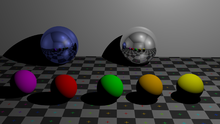
Metallic assurance created in Blender.
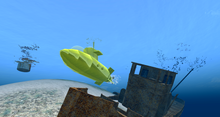
A virtual earth is a false environs, which allows the user to collaborate with animated characters, or interact with other users through the use of animated characters known equally avatars. Virtual worlds are intended for its users to inhabit and interact, and the term today has become largely synonymous with interactive 3D virtual environments, where the users take the form of avatars visible to others graphically.[24] These avatars are normally depicted equally textual, two-dimensional, or iii-dimensional graphical representations, although other forms are possible[25] (auditory[26] and touch sensations for example). Some, but not all, virtual worlds allow for multiple users.
In courtrooms [edit]
Computer-generated imagery has been used in courtrooms, primarily since the early 2000s. However, some experts accept argued that it is prejudicial. They are used to assist judges or the jury to better visualize the sequence of events, show or hypothesis.[27] Notwithstanding, a 1997 study showed that people are poor intuitive physicists and easily influenced by computer generated images.[28] Thus it is important that jurors and other legal decision-makers be made enlightened that such exhibits are merely a representation of one potential sequence of events.
Motion-capture [edit]
Estimator-generated imagery is oftentimes used in conjunction with motion-capture to meliorate cover the faults that come with CGI and animation. Computer-generated imagery is limited in its practical application past how realistic it can look. Unrealistic, or badly managed reckoner-generated imagery tin can effect in the Uncanny Valley effect.[29] This effect refers to the human ability to recognize things that await eerily similar humans, but are slightly off. Such ability is a fault with normal computer-generated imagery which, due to the complex anatomy of the human-trunk, can oftentimes fail to replicate it perfectly. This is where motion-capture comes into play. Artists tin utilise a motion-capture rig to get footage of a human performing an action then replicate it perfectly with figurer-generated imagery and so that it looks normal.
The lack of anatomically correct digital models contributes to the necessity of movement-capture as it is used with computer-generated imagery. Considering computer-generated imagery reflects only the exterior, or pare, of the object being rendered, it fails to capture the infinitesimally pocket-sized interactions between interlocking muscle groups used in fine motor-control, like speaking. The constant motion of the confront equally information technology makes sounds with shaped lips and natural language move, along with the facial expressions that continue with speaking are difficult to replicate by manus.[30] Movement capture can grab the underlying movement of facial muscles and improve replicate the visual that goes along with the audio, like Josh Brolin'south Thanos.
See as well [edit]
- 3D modeling
- Cinema Enquiry Corporation
- Cel shading
- Anime Studio
- Animation database
- Listing of calculator-animated films
- Digital image
- Parallel rendering
- Photoshop is the industry standard commercial digital photo editing tool. Its FOSS counterpart is GIMP.
- Poser DIY CGI optimized for soft models
- Ray tracing (graphics)
- Real-time computer graphics
- Shader
- Virtual human
- Virtual studio
- Virtual Physiological Man
References [edit]
Citations [edit]
- ^ a b c d "fourteen groundbreaking movies that took special effects to new levels". Insider.com.
- ^ Halverson, Dave (December 2005). "Anime Reviews: The Professional person Golgo xiii". Play. No. 48. Usa of America. p. 92.
- ^ "Archived re-create". Archived from the original on 2021-08-29. Retrieved 2021-08-29 .
{{cite spider web}}: CS1 maint: archived copy as title (link) - ^ Hearn, Marcus (2005). The Cinema of George Lucas. New York City: Harry North. Abrams, Inc. p. 156. ISBN 0-8109-4968-vii.
- ^ "How the Dire Straits' 'Money for Nothing' Video Helped CGI Get Mainstream". 11 March 2019.
- ^ a b c Peitgen 2004, pp. 462–466.
- ^ Game programming gems 2 by Mark A. DeLoura 2001 ISBN 1-58450-054-9 folio 240 [1]
- ^ Digital modeling of material appearance by Julie Dorsey, Holly Rushmeier, François X. Sillion 2007 ISBN 0-12-221181-2 page 217
- ^ Sondermann 2008, pp. viii–15.
- ^ Interactive environments with open-source software: 3D walkthroughs by Wolfgang Höhl, Wolfgang Höhl 2008 ISBN 3-211-79169-eight pages 24-29
- ^ "Light: The art of exposure". GarageFarm. 2020-eleven-12. Retrieved 2020-eleven-12 .
- ^ Advances in Computer and Information Sciences and Engineering by Tarek Sobh 2008 ISBN 1-4020-8740-3 pages 136-139
- ^ Encyclopedia of Multimedia Technology and Networking, Volume i by Margherita Pagani 2005 ISBN 1-59140-561-0 page 1027
- ^ Interac storytelling: First Joint International Briefing by Ulrike Spierling, Nicolas Szilas 2008 ISBN 3-540-89424-1 pages 114-118
- ^ Total Knee Arthroplasty past Johan Bellemans, Michael D. Ries, Jan M.K. Victor 2005 ISBN 3-540-20242-0 pages 241-245
- ^ I. Waechter et al. Patient Specific Models for Minimally Invasive Aortic Valve Implantation in Medical Prototype Computing and Computer-Assisted Intervention -- MICCAI 2010 edited by Tianzi Jiang, 2010 ISBN 3-642-15704-1 pages 526-560
- ^ Fabric modeling and animation by Donald Business firm, David East. Breen 2000 ISBN 1-56881-090-3 page twenty
- ^ Moving picture and photography past Ian Graham 2003 ISBN 0-237-52626-3 page 21
- ^ Designing clothes: civilization and organization of the way industry by Veronica Manlow 2007 ISBN 0-7658-0398-iv page 213
- ^ Handbook of Virtual Humans by Nadia Magnenat-Thalmann and Daniel Thalmann, 2004 ISBN 0-470-02316-3 pages 353-370
- ^ Mathematical optimization in reckoner graphics and vision by Luiz Velho, Paulo Cezar Pinto Carvalho 2008 ISBN 0-12-715951-vii page 177
- ^ a b c GPU-based interactive visualization techniques by Daniel Weiskopf 2006 ISBN 3-540-33262-6 pages 1-viii
- ^ Trends in interactive visualization by Elena van Zudilova-Seinstra, Tony Adriaansen, Robert Liere 2008 ISBN 1-84800-268-eight pages 1-7
- ^ Cook, A.D. (2009). A case study of the manifestations and significance of social presence in a multi-user virtual environment. MEd Thesis. Available online
- ^ Biocca & Levy 1995, pp. 40–44.
- ^ Begault 1994, p. 212.
- ^ Reckoner-generated images influence trial results The Chat, 31 October 2013
- ^ Kassin, South. Thou. (1997). "Reckoner-animated Brandish and the Jury: Facilitative and Prejudicial Effects". Law and Man Beliefs. forty (3): 269–281. doi:x.1023/a:1024838715221. S2CID 145311101. [2]
- ^ Palomäki, Jussi; Kunnari, Anton; Drosinou, Marianna; Koverola, Mika; Lehtonen, Noora; Halonen, Juho; Repo, Marko; Laakasuo, Michael (2018-xi-01). "Evaluating the replicability of the uncanny valley effect". Heliyon. four (11): e00939. doi:x.1016/j.heliyon.2018.e00939. ISSN 2405-8440. PMC6260244. PMID 30519654.
- ^ Pelachaud, Catherine; Steedman, Marking; Badler, Norman (1991-06-01). "Linguistic Issues in Facial Animation". Center for Human being Modeling and Simulation.
Sources [edit]
- Begault, Durand R. (1994). iii-D Sound for Virtual Reality and Multimedia. AP Professional person. ISBN978-0-1208-4735-8.
- Biocca, Frank; Levy, Mark R. (1995). Communication in the Age of Virtual Reality. Lawrence Erlbaum Associates. ISBN978-0-8058-1549-viii.
- Peitgen, Heinz-Otto; Jürgens, Hartmut; Saupe, Dietmar (2004). Anarchy and Fractals: New Frontiers of Scientific discipline. Springer Scientific discipline & Business Media. ISBN978-0-387-20229-seven.
- Sondermann, Horst (2008). Light Shadow Infinite: Architectural Rendering with Movie theatre 4D. Vienna: Springer. ISBN978-3-211-48761-seven.
External links [edit]
- A Critical History of Reckoner Graphics and Animation – a course page at Ohio State University that includes all the course materials and all-encompassing supplementary materials (videos, articles, links).
- CG101: A Computer Graphics Industry Reference ISBN 073570046X Unique and personal histories of early computer graphics product, plus a comprehensive foundation of the industry for all reading levels.
- F/X Gods, by Anne Thompson, Wired, February 2005.
- "History Gets A Computer Graphics Brand-Over" Tayfun King, Click, BBC Globe News (2004-11-19)
- NIH Visible Human being Gallery
Source: https://en.wikipedia.org/wiki/Computer-generated_imagery
Posted by: tiradomanter.blogspot.com
0 Response to "Describe How Computer Generated Imagery Works. How Has It Benefited Animation?"
Post a Comment